AMD's $49B Xilinx Bet: Three Years Later, Where's the Innovation?
AMD's $49 billion Xilinx acquisition three years later: ambitious AI/datacenter goals versus disappointing FPGA revenue decline reality.
Three years have passed since AMD completed its landmark $49 billion acquisition of Xilinx in February 2022, marking one of the semiconductor industry’s largest deals. At the time, AMD CEO Lisa Su boldly proclaimed that the combination would create “the industry’s high-performance and adaptive computing leader,” positioning the merged entity to capitalize on the explosive growth in AI, edge computing, and data center markets. The acquisition promised to unite AMD’s CPU and GPU prowess with Xilinx’s FPGA and programmable computing expertise, theoretically creating a powerhouse capable of addressing the full spectrum of computing workloads.
However, as we examine the integration three years later, the question remains: has this massive bet paid off, or has AMD simply acquired an expensive collection of traditional FPGA products in markets that are increasingly being disrupted by AI accelerators and specialized chips?
Why did AMD want Xilinx?
As the world's largest FPGA manufacturer, Xilinx has significant influence in markets such as 5G communications, automotive, industrial, aerospace, and defense. However, AMD's acquisition of Xilinx was certainly not driven by these markets. According to Lisa Su's plan, the focus is undoubtedly on future-oriented fields with greater growth potential, such as AI, data centers, and edge computing.
At the technical level, Xilinx's FPGA, programmable SoC, and AI engine technologies form a strong complement to AMD's CPUs and GPUs, providing more efficient solutions for data-intensive applications and embedded AI.
Additionally, Xilinx's excellent engineers and long-accumulated IPs are valuable assets. However, it remains unclear which IPs will truly achieve a "1+1>2" effect.
On FPGAs in Data Centers
Although this article focuses on AMD and Xilinx, we must revisit some history. Intel's acquisition of Altera was originally influenced by Microsoft, which had been hyping the potential of FPGAs in data centers and pushing for the deal. After Intel's acquisition, Microsoft did purchase many of Intel's high-end FPGAs for data centers, briefly enabling Intel to lead Xilinx in the high-end FPGA sector. However, the outcome was evident: Intel invested too much in data centers, causing its market share in traditional FPGA applications to decline. In the data center domain, Microsoft also found that FPGAs did not meet expectations. With the rapid growth of AI large model training, NVIDIA's GPUs became the market's ultimate choice.
After the Acquisition
Following the acquisition, AMD established the Adaptive and Embedded Computing Group (AECG), led by former Xilinx CEO Victor Peng, focusing on FPGA and SoC roadmaps. Unlike Intel's PSG division (which was essentially Altera) after its acquisition, AECG does not operate as an independent entity. According to AMD's financial reports, FPGA business exists not only in the embedded sector but also in data centers, which we will discuss later.
First, let's look at the product updates from Xilinx after the acquisition (software updates, which are hardware-based, are not listed here):
Versal Premium Series Gen 2
Supports PCIe Gen 6 and CXL 3.1 with data transfer rates up to 64 Gb/s.
Integrates 400 Gbps encryption engines and PCIe IDE for data security.
Supports DDR5 RDIMM and LPDDR5X memory.
Provides 18.5 million logic units, doubling logic density and I/O bandwidth.
Versal RF Series
Integrates 18 GHz RF-ADC/DAC with a sampling rate of 32 GSPS.
Delivers 3x computing power per unit area compared to competitors, optimizing SWaP (Size, Weight, and Power).
Includes hard IP, programmable logic, DSP, and AI engines.
Spartan UltraScale+ FPGA
16 nm FinFET process, reducing power consumption by 30%-60%.
Highest I/O to logic unit ratio, supporting protocols like PCIe Gen4.
Zynq UltraScale+ RFSoC
Optimizes RF data converters and SD-FEC cores, reducing power consumption and area by 50%.
Integrates high-speed ADC/DAC and ARM Mali-400 GPU.
From these updates, the development appears conventional. If not acquired by AMD, Xilinx likely would have followed a similar roadmap. This makes sense: AMD acquired Xilinx to combine their products or leverage Xilinx's strengths to complement its own portfolio, rather than investing heavily in FPGAs alone. Before the acquisition, the FPGA market was expected to grow slowly and steadily, so AMD did not anticipate exceeding market expectations through FPGA products.
AMD's financial reports do not specify which FPGA series generates the highest revenue. Based on anecdotal evidence, the Ultrascale(+) series currently contributes the most revenue, while the highly anticipated Versal series has not seen large-scale adoption in China.
It's worth noting that after Intel acquired Altera, it introduced some Xeon+FPGA chip SKUs, which were quickly phased out. The "killer combination" of x86 CPU + FPGA never materialized, indicating technical challenges such as high power consumption, heat dissipation, and software compatibility.
FPGA Revenue Performance
Before the acquisition, Xilinx's total revenue in fiscal 2021 was $3.15 billion, roughly flat from $3.16 billion in fiscal 2020. Despite global supply chain challenges and trade restrictions, Xilinx grew in key markets, particularly in Data Center (DCG), Wireless Communications (WWG), and Automotive (ABC).
As mentioned, AMD's data center and embedded businesses both include FPGA operations:
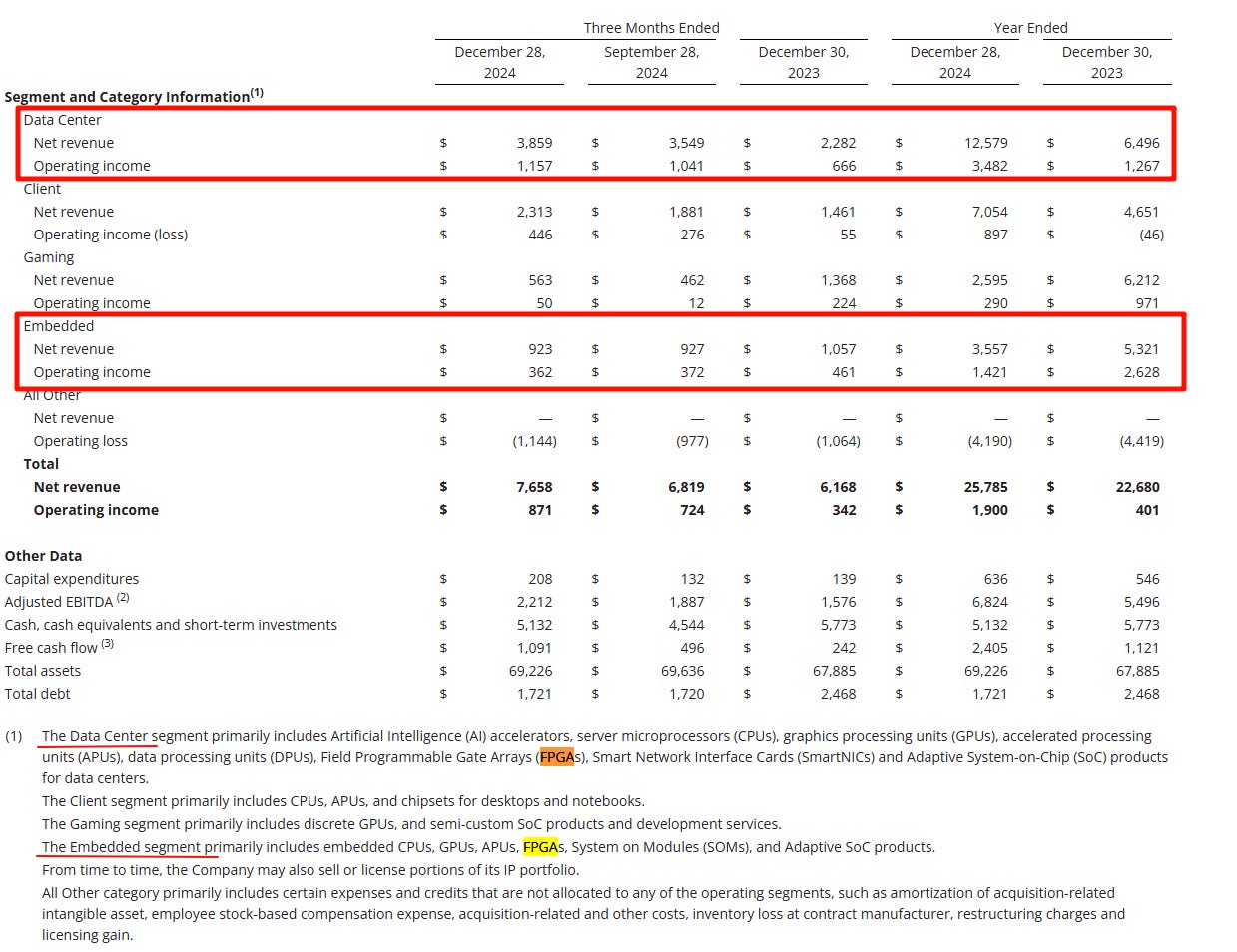
What differentiates the FPGA businesses in these two departments? Financial reports explain:
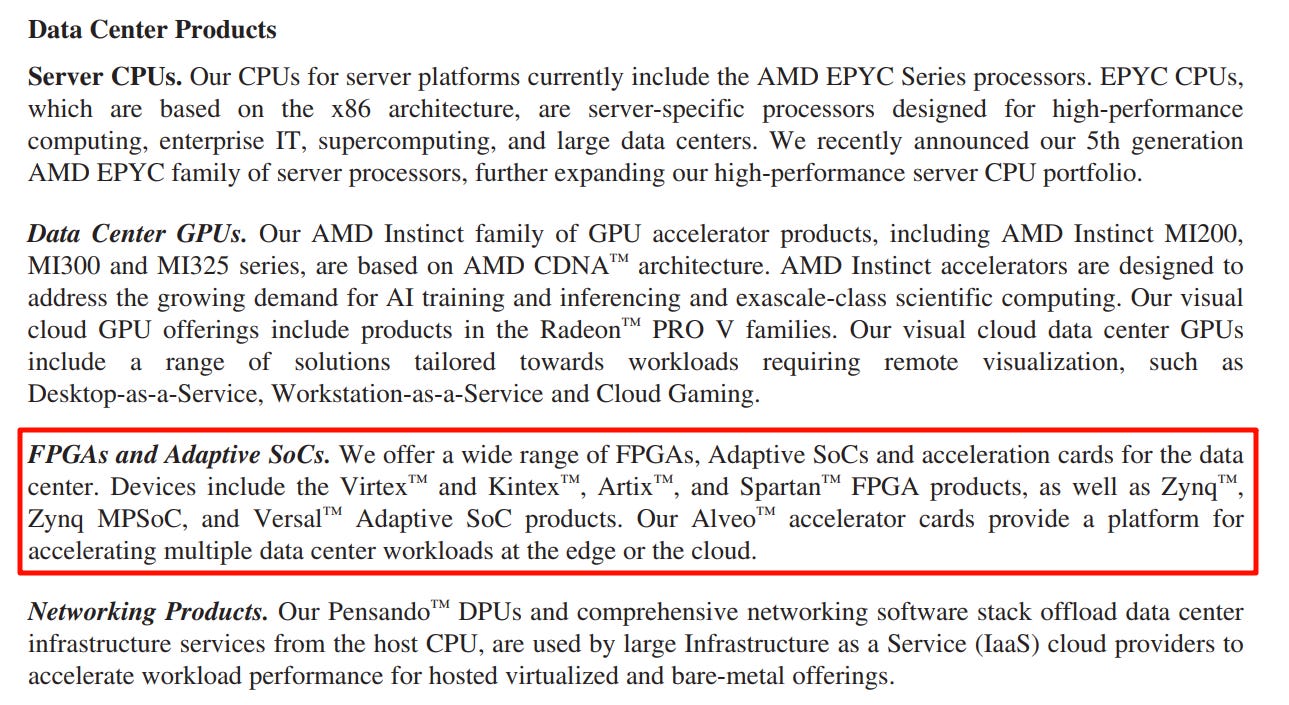
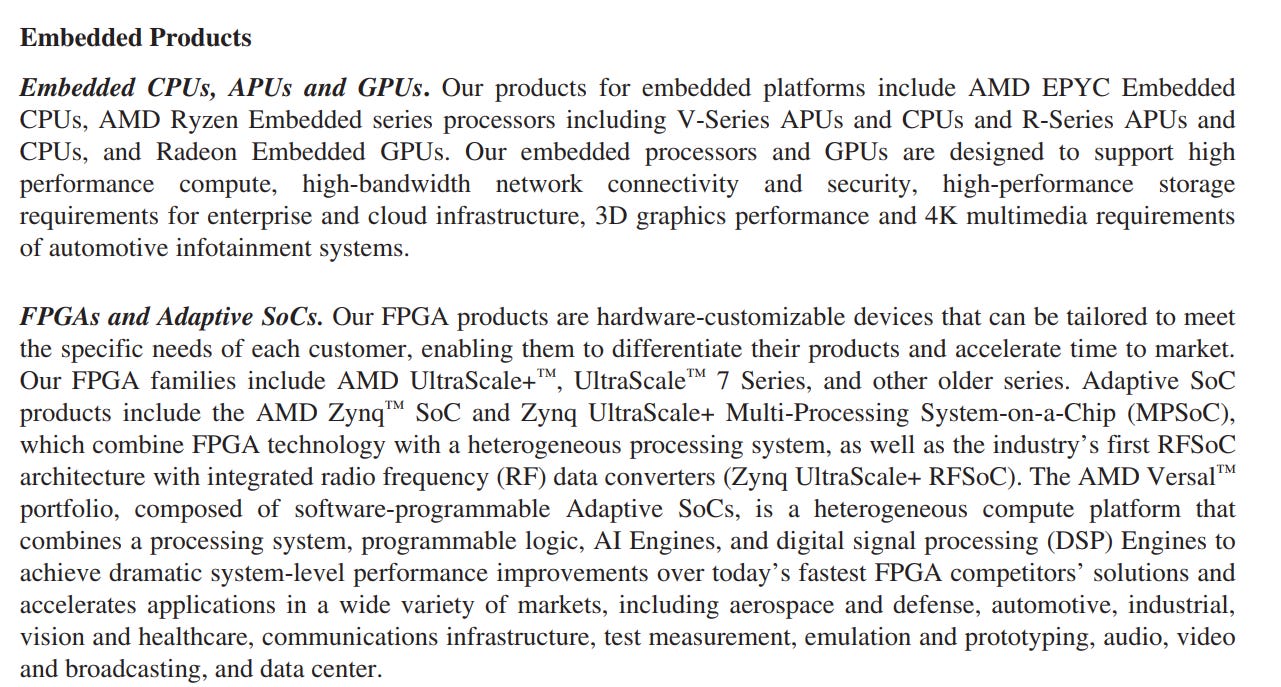
Thus, it is difficult to isolate FPGA revenue. Let's first examine post-acquisition embedded business revenue in traditional FPGA applications:
2022 Revenue
Embedded segment revenue for 2022 was not directly listed in financial reports but can be inferred from 2023 data. With 2023 embedded revenue at $5.3 billion (up 17% YoY), 2022 revenue is estimated at $5.3B / 1.17 ≈ $4.53B. Note that the acquisition closed in February 2022, so 2022 data reflects only part of the year (February-December).2023 Revenue
According to AMD's 2023 Q4 and full-year report, embedded segment revenue was $5.3 billion, up 17% YoY, driven by full-year inclusion of Xilinx revenue, demonstrating initial integration success.2024 Revenue
AMD's 2024 Q4 and full-year report shows embedded segment revenue at $3.6 billion, down 33% YoY, attributed to mixed market demand and customer inventory normalization.
U.S. bans also play a significant role: high-end FPGAs cannot be sold to China. Although they can still be obtained, this increases costs and reduces demand. Additionally, with the development of China's mid-to-low-end FPGAs, more companies are adopting domestic FPGAs.
Cloud Computing Business
As noted, the Xilinx acquisition aimed to strengthen AMD's AI and cloud computing businesses. According to the 2024 financial report, AMD's data center business grew significantly, reaching $12.6 billion (up 94% YoY), driven by AMD Instinct GPU and EPYC CPU sales. However, since FPGA usage in cloud computing is not documented, its contribution cannot be evaluated.
In summary, three years after acquiring Xilinx, AMD has not yet delivered a groundbreaking product that surprises the tech industry. FPGA development remains conventional. While AMD's data center business grew rapidly last year, the role of FPGAs therein is unclear. In traditional FPGA markets, AMD's revenue dropped by 33% in 2024.